NDP Rushes Treaties Through Legislature While Neighbouring First Nations Threaten to Blockade a BC Hydro Dam
The K'ómoks and Kitselas treaties were introduced with no consultation with adjacent nations who hold overlapping land claims. Now those nations are threatening blockades and legal action — and the NDP is still pressing forward.
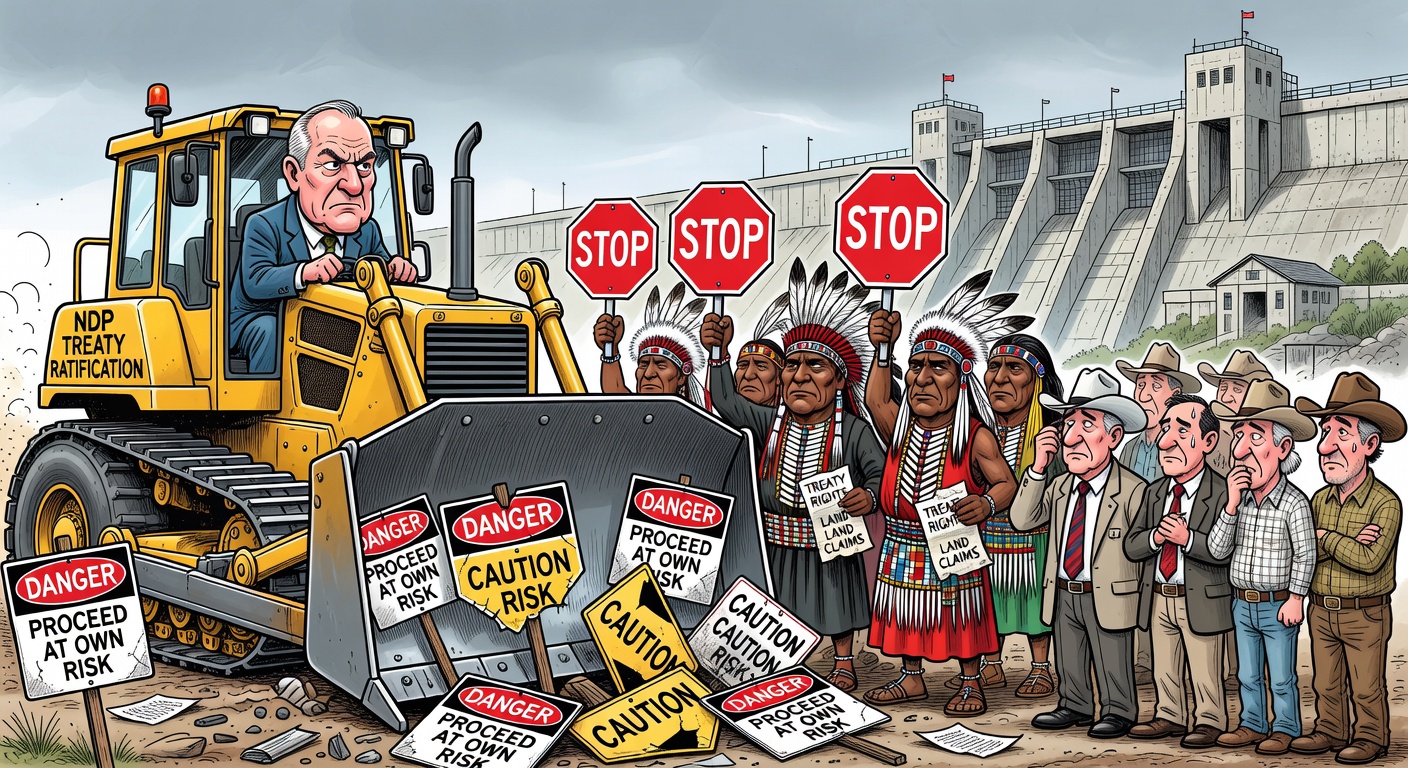
The BC NDP has a consistent playbook when it comes to Indigenous policy: announce a deal with one group, celebrate the relationship, and ignore the other groups whose territory overlaps. That playbook is playing out in real time in the BC Legislature right now — with consequences that could include blockades of critical provincial infrastructure.
Two new treaties — one for the K'ómoks Nation on central Vancouver Island, another for the Kitselas Nation near Terrace and Port Essington in northwest BC — are currently before the legislature for ratification after more than 30 years of negotiations. By any measure, reaching a modern treaty agreement is an achievement worth marking.
The problem is who wasn't at the table.
Nations With Overlapping Claims Say They Were Cut Out
The Union of BC Indian Chiefs is now publicly backing a coalition of First Nations that are demanding an immediate 180-day pause on debate of both treaties. On April 28 in Victoria, leaders from the Wei Wai Kum First Nation, the Nine Allied Tribes, and the Lax Kw'alaams Band stood together to deliver a stark message to the NDP government: slow down or face the consequences.
Wei Wai Kum Chief Chris Roberts said that 80 per cent of the land recognized as K'ómoks territory in the new treaty overlaps with lands claimed by the Laich-kwil-tach — the southern group of four nations that includes the Wei Wai Kum, all part of the larger Kwakwaka'wakw First Nations family.
"You can't say this is about partnerships and respect and then push the legislation forward while ignoring the very nations that it impacts."
— Lax Kw'alaams Mayor Gary Reece, Victoria, April 28, 2026The nations have been in Victoria for two weeks. In that time, they've received little to no movement from the NDP government. When they sought direct talks with the Kitselas chief negotiator, they were told the delay was "not necessary and not appropriate."
What's Being Put at Risk
Chief Roberts wasn't speaking in abstractions when he explained what ignoring the Wei Wai Kum's territorial claims would mean in practice. He named the assets sitting inside the disputed territory — assets that provide services to hundreds of thousands of British Columbians:
Infrastructure in the Disputed Territory
- A BC Hydro dam that generates nearly 50% of Vancouver Island's electricity needs
- The Island Highway, running directly through Wei Wai Kum traditional lands and past reserves
- An $800 million wind farm project intended to advance clean energy for the entire North Valley region
"Those are just some of the things that are being put at risk and jeopardized by this continued inaction and forcing this treaty ahead," said Roberts.
He was not ambiguous about what "other steps" the nation might take if the NDP refuses to pause the legislation. The implication of a blockade — of a highway, or of a dam access road — is not theoretical. It is a direct consequence the province is choosing to risk by refusing to engage.
The UBCIC Steps In
The Union of BC Indian Chiefs, one of BC's most prominent First Nations organizations, sent vice-president Linda Innes (of the Gitxaała Nation) to represent Grand Chief Stewart Phillip at the Victoria gathering. Grand Chief Phillip has been tending to his wife, Joan Phillip — the NDP MLA for Vancouver-Strathcona — who is currently hospitalized.
Even amid that personal difficulty, the UBCIC made its position clear: the NDP cannot claim to govern through reconciliation while steamrolling First Nations whose territories are directly affected by legislation before the house.
"The Crown should not be remotely surprised that neighbouring nations are raising their local opposition to the two pieces of related treaty legislation before the legislature."
— UBCIC Vice-President Linda Innes, Victoria, April 28, 2026What the Treaties Actually Do
The K'ómoks treaty gives the nation ownership of more than 34 square kilometres of land on Vancouver Island, self-government rights, and $56 million in funding. The Kitselas treaty gives that nation ownership of more than 38 square kilometres near Terrace, self-government rights, and $148 million in one-time transfers and ongoing funding.
These are meaningful commitments — financial and jurisdictional — that will bind the province for decades. The NDP is asking the legislature to ratify them with a 30-year negotiation process behind them, but with adjacent nations now threatening legal challenges, the question is whether this ratification will hold up in court or be challenged as soon as it's passed.
The Pattern of NDP Indigenous Policy
This situation did not arise in a vacuum. The NDP has repeatedly moved fast on Indigenous policy — signing bilateral agreements, ratifying treaties, passing DRIPA amendments — while insisting the urgency is justified and the process is sound.
Time and again, that speed has come back to bite them. The DRIPA-Gitxaała mineral rights decision. The Richmond-Cowichan Aboriginal title ruling affecting 150+ homeowners. The Haida title agreement that created private property uncertainty across Haida Gwaii. The Heritage Conservation Act rewrite that municipalities, developers, and contractors unanimously opposed.
The NDP governs as if reconciliation can be achieved by moving fast and apologizing later. What it's actually doing is creating legal chaos, infrastructure risk, and Indigenous-to-Indigenous conflict — and then claiming it's all in the service of reconciliation.
If a BC Hydro dam goes offline because the NDP rushed a treaty through the legislature, reconciliation will not be the word that comes to mind.