Who Controls Your Doctor Now? B.C.’s HPOA Needs Sunlight
A viral TikTok is dramatic, but the core issue is real: the NDP’s Health Professions and Occupations Act has changed health-profession regulation in B.C., and patients deserve plain answers about independence, penalties, records access and political control.
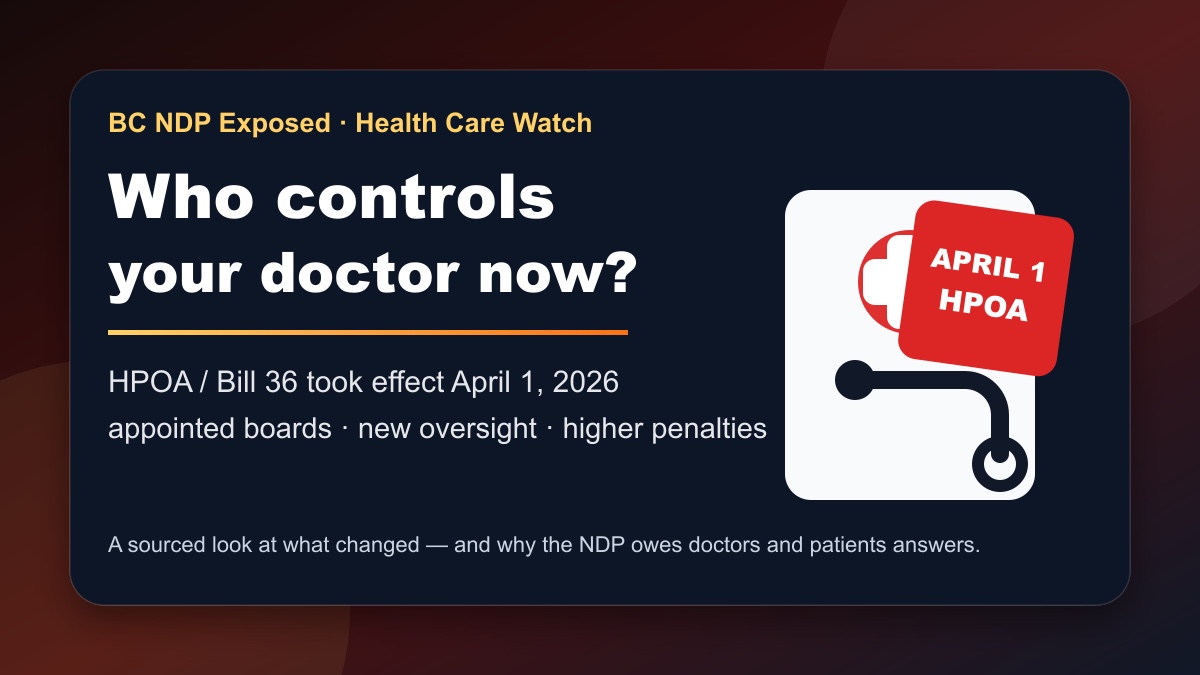
Editorial graphic generated for iVoteNDP.com, May 14, 2026.
Source lead
TikTok creator Unfiltered with Kels posted a viral warning about B.C.’s Health Professions and Occupations Act. This article checks the political issue against public law and government documents.
The strongest political stories are not always the ones where every social-media claim is perfect. Sometimes the real story is simpler: people no longer trust the NDP to draw the line between public safety and state control.
B.C.’s Health Professions and Occupations Act — originally Bill 36 — was passed in 2022 and came into force on April 1, 2026. The government says the new system modernizes regulation, puts patients first, improves cultural safety and strengthens accountability. Critics see something darker: a move away from professional self-regulation toward minister-shaped control over the people who regulate doctors, nurses and other health professionals.
That debate is not a fringe issue. It goes directly to the relationship between patient and practitioner.
What changed
Under the old model, health colleges were built around professional self-regulation. Under the new HPOA framework, B.C. has moved to a smaller number of regulatory colleges and a new governance model. The province says board members are appointed through a competency-based process, with equal numbers of public and professional members.
Supporters call that modernization. But voters are entitled to ask a harder question: when the NDP government writes the law, designs the appointment system and sets broad regulatory objectives, how independent will the regulators really feel when government pressure arrives?
That matters because doctors are not supposed to be political messengers. Patients need to believe their doctor is speaking from medical judgment, not from fear of disciplinary language, reputational punishment or regulatory consequences.
What is confirmed
- Bill 36 became the Health Professions and Occupations Act in 2022.
- The Act came into force on April 1, 2026.
- The new regime changes health-profession governance and college structures.
- The Act contains provisions dealing with false or misleading information, licence requirements, investigations, search powers and penalties.
- The province says board appointments are competency-based and designed to include equal public and professional representation.
The penalty problem
The viral TikTok points to fines and penalties. The Act does include serious enforcement machinery, including offences and penalties that can reach up to $25,000 for individuals and $500,000 for corporations in specified circumstances.
The political problem is not only the dollar figure. The problem is trust. When government creates large penalties in the same regime that governs professional speech, licensing and conduct, it has to be extremely clear about what behaviour is actually being punished.
Doctors should not mislead patients. No serious person argues otherwise. But if the line between professional disagreement and “misleading information” is vague, practitioners may self-censor. In medicine, that can be dangerous. Good care often requires debate, second opinions, uncertainty and the freedom to say, “I do not agree with the official view.”
Records and investigations
The TikTok also warns about access to medical records. The Act contains search and seizure provisions, including sections dealing with detention of seized records and warrantless search in defined circumstances. The B.C. government has publicly argued that these powers do not give government direct access to private medical records, and that they are exercised by independent regulators or inspectors in specific regulatory contexts.
That answer may be legally important, but it is not politically sufficient. Patients hear “warrantless search” and “medical records” in the same statute and they want a plain-language guarantee: who can access what, when, under whose authority, with what notice, and what remedy exists if the power is abused?
The NDP should not treat that concern as misinformation. It should answer it like adults.
The vaccine and licensing question
The Act also allows licensing bylaws to deal with proof of eligibility, including mandatory vaccinations required under another enactment. In plain English: the structure exists for vaccination-related licensing requirements where another law requires them.
That is exactly the kind of clause that requires public trust. British Columbians remember the COVID years. Health professionals remember mandates, firings, shortages, moral pressure and political slogans. If the government wants confidence, it needs to explain the safeguards before the next emergency, not after.
Why the NDP owns the trust crisis
David Eby’s government has a habit of answering criticism with process language. “Modernization.” “Cultural safety.” “Public interest.” “Accountability.” Those words may sound comforting inside a ministry briefing room. They do not reassure a patient who wonders whether their doctor is free to speak honestly.
The NDP does not get to demand trust while centralizing power. It has to earn trust by publishing clear explanations, protecting dissenting professional judgment and proving the new system will not be used as a political discipline machine.
Here are the questions the Health Minister should answer publicly:
Questions for the NDP
- Exactly who appoints college board members, and what role does the minister or ministry play?
- What speech by a practitioner counts as “misleading information,” and who decides?
- Can a doctor be disciplined for a good-faith medical opinion that differs from ministry guidance?
- Who can access patient records during investigations, and what independent safeguards protect patients?
- How will vaccination-related licensing requirements be limited, reviewed and challenged?
- How many doctors or nurses have left B.C. since the Act passed, and what exit data does the ministry track?
The NDP may insist this is all about patient safety. Fine. Then prove it.
Publish the safeguards. Explain the appointment process in plain language. Define the speech rules. Show the appeal rights. Report the workforce numbers. Commit that professional disagreement will not become professional punishment.
The bottom line: patients do not want doctors who are reckless. They also do not want doctors who are afraid. A health system that cannot tolerate honest professional judgment is not safer. It is weaker.
Sources
B.C. Health Professions and Occupations Act, SBC 2022 c. 43; Government of B.C. HPOA implementation materials and public Q&A; B.C. Legislative Assembly Bill 36 record; public TikTok by Unfiltered with Kels, April 2026.