Eby’s Third Heritage Act Try Looks Like Land Back by Legislation
Tom Fletcher’s latest Western Standard column connects the Heritage Conservation Act fight to the bigger NDP pattern: court-created uncertainty, secret consent talks and another land-use rewrite pushed before the public sees the real draft.
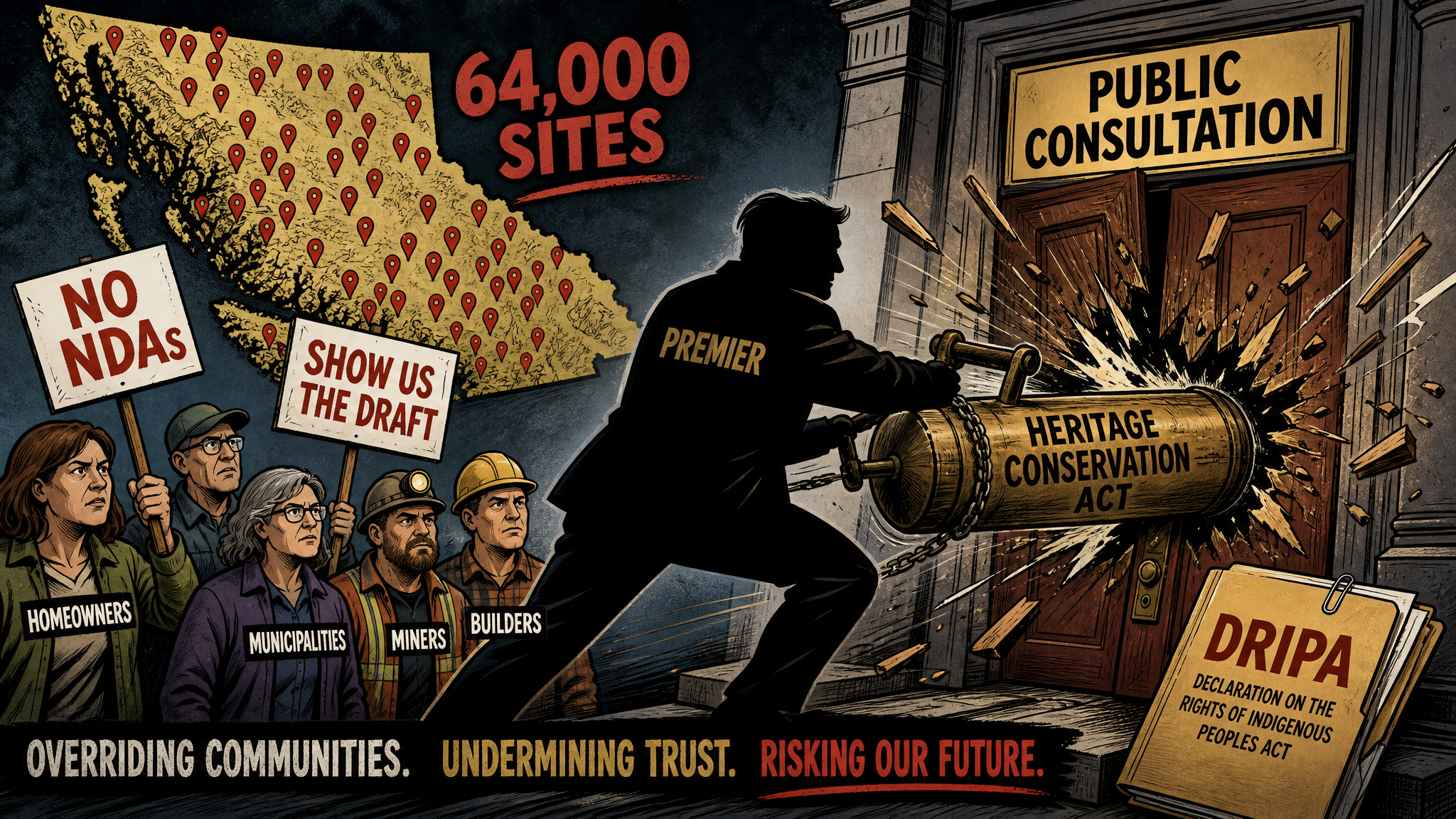
Editorial graphic generated for iVoteNDP.com, May 18, 2026.
Tom Fletcher’s new Western Standard column, “David Eby’s push for indigenous rights sparks new revolt,” puts the Heritage Conservation Act fight exactly where it belongs: inside the larger B.C. land-back architecture.
Fletcher — a veteran B.C. political journalist, X: @tomfletcherbc — describes the file as the “other, other land back agenda.” That is the right frame. British Columbians are already dealing with court decisions that cloud private property and Crown land. They are also watching the NDP negotiate “shared decision-making” and “consent” arrangements behind closed doors with selected Indigenous groups claiming title across huge parts of the province.
Now comes the third channel: heritage law.
Why this law matters
The Heritage Conservation Act governs B.C.’s heritage register, which Fletcher notes contains roughly 64,000 protected sites, about 90 per cent of them Indigenous in origin. These can include shell middens, rock art, culturally modified trees and other archaeological or cultural sites.
That sounds narrow until government starts expanding the definition of what counts as protected heritage. Earlier discussion material pointed toward broader First Nations “values” rather than only scientific or archaeological values, including cultural landscapes, mortuary landscapes, oral histories, place names, language, knowledge, objects and places within Indigenous worldview.
After backlash, the government says some of the most alarming ideas have been dropped, including explicit protection for “intangible heritage” such as songs, ceremonies, food and traditions, direct enforcement powers for Indigenous communities, and expanded shared decision-making under the Act.
But the revolt has not gone away. It has grown.
What is sourced
- The B.C. government delayed spring Heritage Conservation Act amendments in January 2026 after pressure for more consultation.
- Daily Hive reported UBCM, UDI, AME, MABC and ICBA refused NDA restrictions tied to a provincial summary of proposed amendments.
- Fletcher reports the same coalition objected that NDAs would stop them from discussing changes with their own members.
- ICBA’s Chris Gardner argued the government appeared to be moving toward cabinet within days of consultation closing.
- Stakeholders agree permitting is already backlogged, with archaeological assessments often taking months or longer.
No NDAs for laws that affect everyone
The coalition response is the real story. The Union of BC Municipalities, Association for Mineral Exploration, Mining Association of BC, Independent Contractors and Businesses Association and Urban Development Institute are not fringe voices. They represent local governments, builders, miners, contractors and developers — the people who will have to operate under whatever Eby’s government writes.
Their message is simple: no, they will not sign non-disclosure agreements just to see a summary of legislation that could affect their members and the public.
That should not be controversial. If a law can affect housing permits, mining exploration, municipal infrastructure, disaster rebuilding and private land use, the draft should be public. Stakeholders should be able to discuss it with their members. British Columbians should see the rules before cabinet locks them in.
Consultation or theatre?
Fletcher quotes ICBA president Chris Gardner warning that within days of consultation closing, the ministry was already circulating material tied to a formal request for legislation to cabinet. Gardner’s point is blunt: nobody believes detailed submissions from local governments could be read, synthesized and reflected in final policy that quickly.
That is the NDP pattern. Consultation becomes a stage prop. The public talks. The stakeholders submit. Then the government proceeds with the plan it already wanted.
This is especially dangerous under DRIPA, because the changes are not just administrative. They shape who has practical power over land, permits, timelines, investment and local decisions. A clogged heritage branch plus expanded rules equals more delay, more uncertainty and more leverage for closed-door decision-making.
The bottom line
B.C. needs a heritage system that protects real archaeological and cultural sites. Nobody serious is arguing otherwise. But protection cannot become a blank cheque for secret land-use power.
If Eby’s government has removed the worst ideas, publish the draft. If the process is fair, drop the NDAs. If the law will not create a new land-back veto through the side door, prove it in plain language.
Fletcher is right to connect the dots: the Heritage Conservation Act is not a side issue. It is part of the same NDP land-use machine that is already destabilizing property rights, resource development and local democracy across B.C.
Sources
Tom Fletcher / Western Standard, “David Eby’s push for indigenous rights sparks new revolt” (text supplied May 18, 2026; X: @tomfletcherbc); Daily Hive, B.C. cities and business groups oppose Heritage Conservation Act NDA process; Province of B.C., continuing engagement on Heritage Conservation Act; UBCM, Province delays Heritage Conservation Act legislation.