Eby Got the Closed-Door Meeting. Carney Had Already Set the Pipeline Terms.
B.C. needs jobs, revenue and investment certainty. After Wednesday’s Vancouver meeting, the public still has no clear win from Premier Eby.
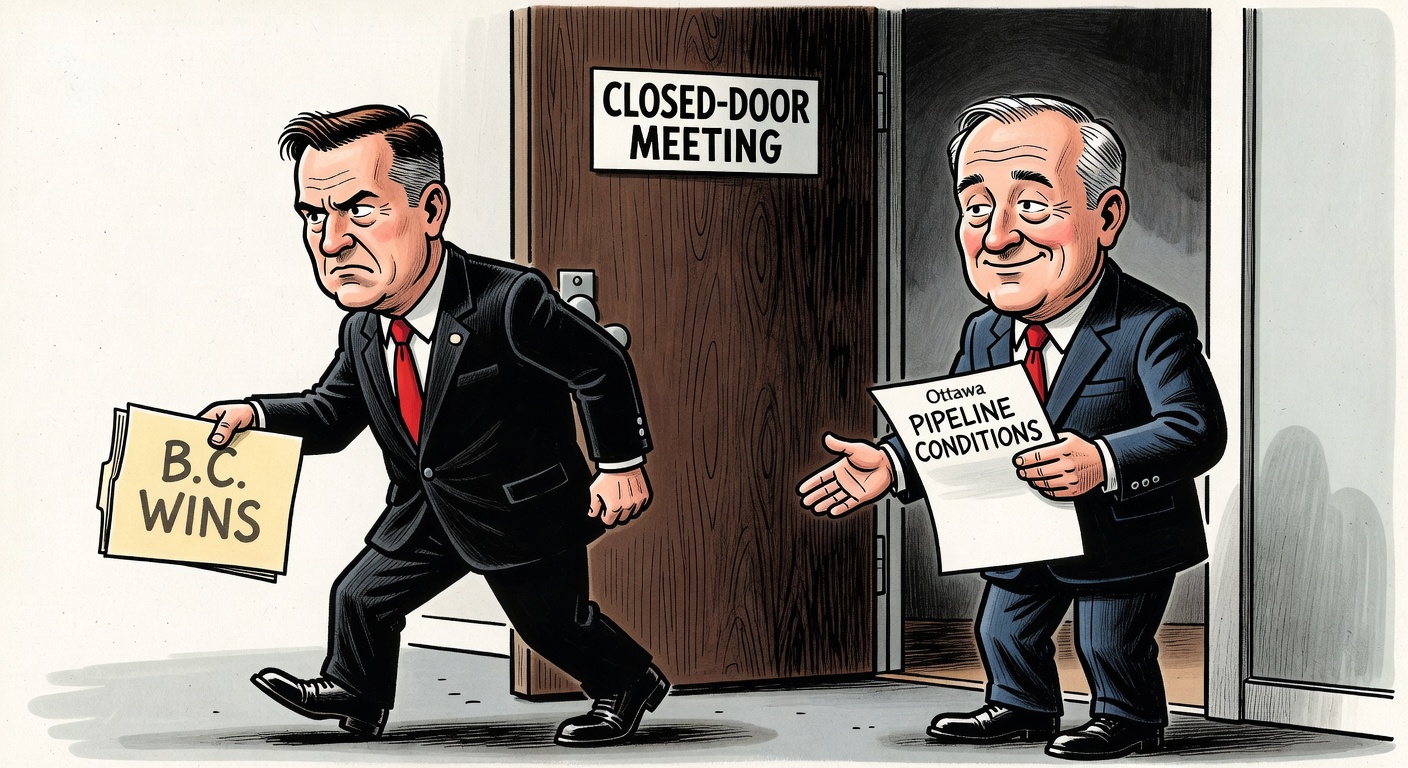
Editorial cartoon generated for iVoteNDP.com, May 21, 2026.
Premier David Eby finally got the closed-door meeting he wanted with Prime Minister Mark Carney in Vancouver on Wednesday. The problem for British Columbians is what came before it: Carney had already publicly framed the terms for any possible Alberta-to-B.C.-coast pipeline.
Canadian Press reporting carried by CityNews said Carney listed prerequisites including the Pathways carbon-capture project, “substantial” economic and financial benefits for British Columbia, and First Nations consultation that he called non-negotiable. That is not a project approval. It is not a route. It is not a proponent. It is Ottawa setting the checklist while B.C.’s premier walks into a private room.
Eby’s office said B.C. and Ottawa agreed to enter negotiations on B.C.’s economic priorities. Good. But British Columbians are entitled to ask a harder question: after years of debt, job anxiety and stalled investment confidence, what exactly did Eby bring home?
The pipeline fight is bigger than one project
Eby has attacked Ottawa’s attention to Alberta, warning that Canada cannot work if “separatist premiers” get all the federal attention and saying bad behaviour should not be rewarded. That is his political argument. But the governing question is different: can Eby secure actual benefits for B.C. workers, communities and taxpayers when Ottawa is already dictating the conditions?
The province needs clarity on ports, LNG, mining, forestry, transmission, housing-supporting infrastructure and the permitting climate that decides whether capital comes here or goes somewhere else. If the NDP wants credit for standing up for B.C., it should publish the asks, the timelines and the measurable outcomes.
Respect consultation, but stop hiding the economics
First Nations consultation is a legal and moral reality, and Carney was right to say it cannot be treated as optional. The issue is not whether consultation happens. The issue is whether the NDP uses process as a shield while avoiding plain answers about jobs, revenues, risk, compensation and who has final decision-making power.
Questions Eby should answer now
- What specific economic benefits did B.C. demand from Ottawa on Wednesday?
- Will any pipeline-related negotiations be reported publicly before decisions are made?
- How will the province protect resource jobs while meeting consultation obligations?
- What benchmarks will prove this meeting produced more than a photo-op?
There is no need to pretend a pipeline is approved. It is not. But there is also no excuse for a premier to emerge from a closed-door meeting with talking points instead of a public ledger of B.C.’s interests.
The bottom line: Eby wanted attention from Ottawa. He got the meeting. Now British Columbians deserve the receipts — because “negotiations” is not the same thing as paycheques, investment, lower debt or a stronger provincial economy.