If DRIPA Can Reach ICBC, What Else Is Eby Hiding?
The premier finally put two Declaration Act examples on the record. They do not narrow the problem. They prove British Columbians deserve the full list.
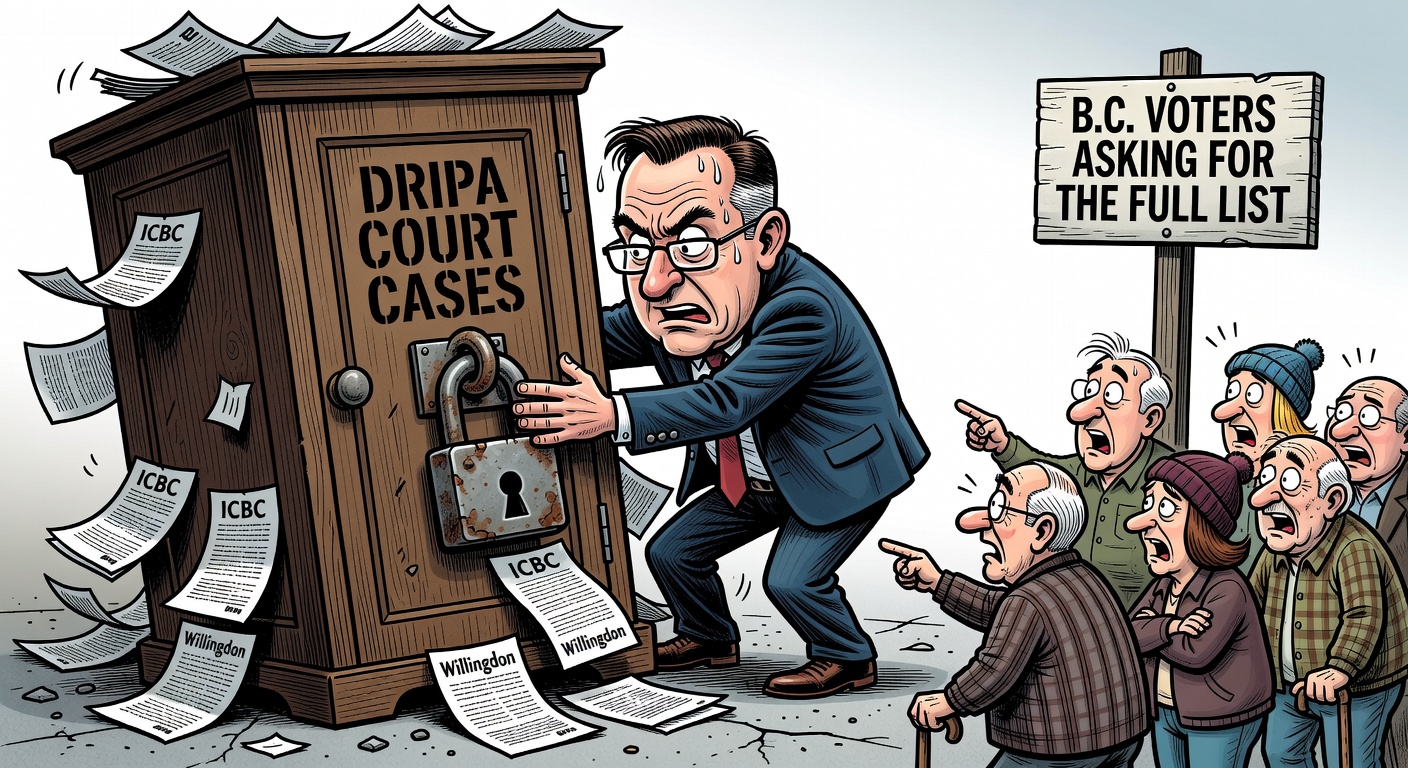
iVoteNDP editorial cartoon, May 30, 2026.
The question is no longer whether DRIPA has reached unexpected files. The question is how many files the NDP still refuses to show British Columbians.
Premier David Eby has finally revealed two examples from the court-case list he previously would not disclose. Rob Shaw reported in Northern Beat that Eby named an ICBC enhanced-care benefits dispute and the Willingdon School for Girls class action as cases where litigants cited B.C.’s Declaration on the Rights of Indigenous Peoples Act, commonly called DRIPA or the Declaration Act, after the Gitxaała decision.
That matters because Eby did not mention these cases in a vacuum. The premier had already said government identified about 20 cases amended after the December Gitxaała ruling. His government used that claim to justify urgent legal changes. Yet, according to Shaw’s report, Eby still refused to release the full list, saying disclosure would reveal legal advice and require government to interpret what litigants intended.
That answer is not good enough. If the NDP can cite the existence of 20 cases to demand legislative urgency, voters are entitled to know what kind of cases they are. The public does not need cabinet’s privileged legal advice. It does need a basic map of where the premier says his own law is now showing up.
The ICBC example should make ordinary British Columbians sit up. Shaw reported it involved a claimant whose enhanced-care benefits were cancelled after he did not attend a medical examination, with the claimant citing DRIPA, UNDRIP, Gitxaała and the Interpretation Act in a matter before the B.C. Court of Appeal. That is not a mine site, pipeline corridor or treaty negotiation. It is the public auto insurer.
The Willingdon example is different, and it must be handled carefully. The underlying class action involves serious allegations by former residents of the Willingdon School for Girls, including abuse claims that have not been tested here. The accountability issue is not whether those plaintiffs deserve a hearing. They do. The issue is that Eby’s government has now admitted the Declaration Act is being invoked in a historic institutional-abuse lawsuit, while still keeping the broader case list secret.
The BC Conservatives seized on the disclosure and demanded the full list, arguing the two examples show DRIPA’s reach is not confined to land, resource or private-property disputes. Strip away the partisan framing and the demand is reasonable: if ICBC and Willingdon are on the record, what else is on the list?
For years, the NDP sold DRIPA as certainty. Now Eby is asking the public to trust him that the uncertainty is serious enough for fast legal repair, but not transparent enough for taxpayers to inspect. That is not reconciliation. That is governing by hidden ledger. Release the list.
Sources and records
- Rob Shaw, Northern Beat, May 28, 2026: Premier David Eby reveals diversity of court cases relying on Declaration Act
- Conservative Party of BC, May 28, 2026: demand to release full DRIPA-related court-case list
- B.C. Court of Appeal, Gitxaala v. British Columbia (Chief Gold Commissioner), 2025 BCCA 430
- B.C. Declaration on the Rights of Indigenous Peoples Act