One-Third of Metro Vancouver Wants an Inquiry. Will Victoria Let Taxpayers See Inside?
Surrey says the demand for scrutiny now represents about one million residents. That makes this a provincial accountability test, not a local grudge match.
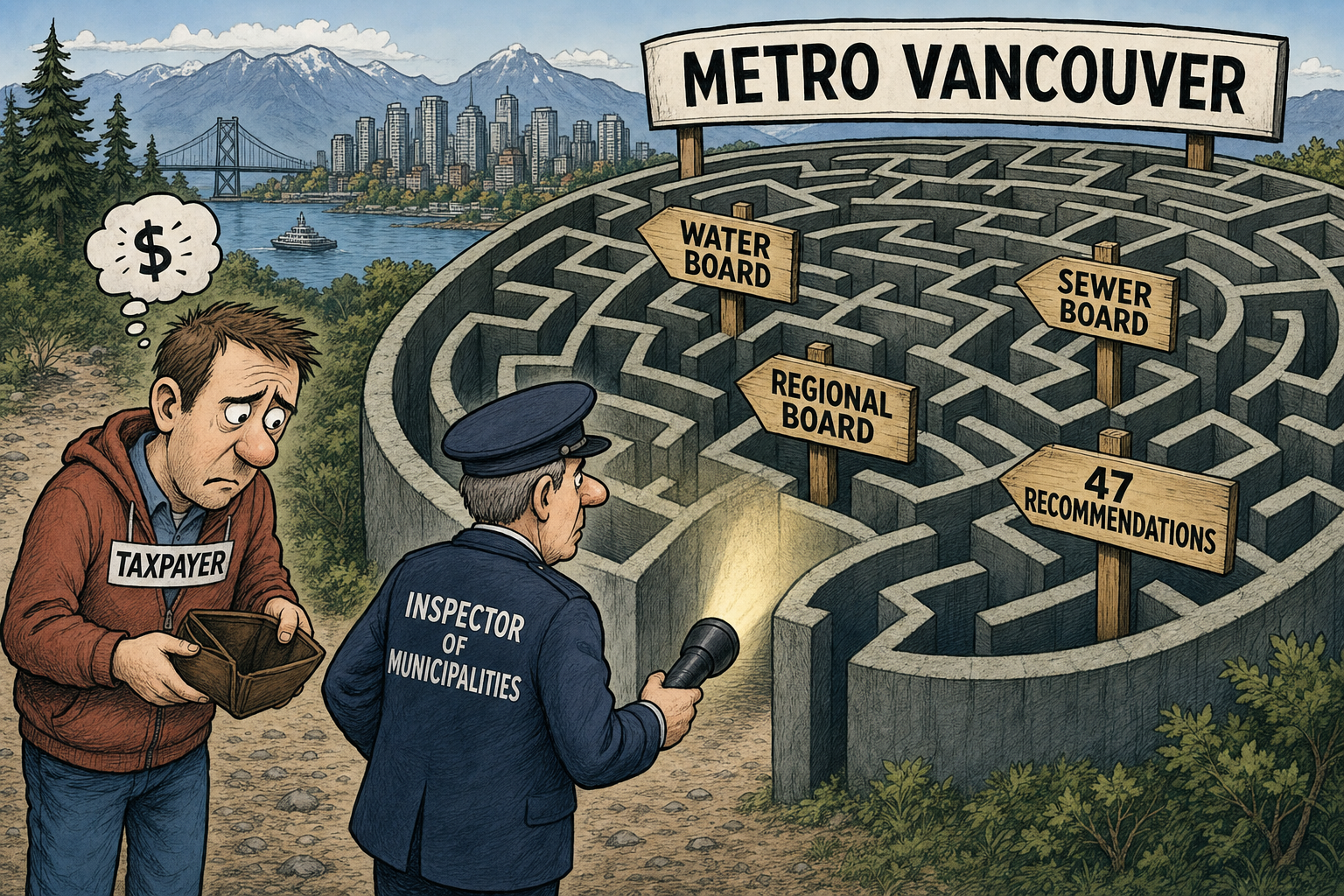
Metro Vancouver’s governance problem is no longer just Surrey’s complaint. On Friday, Surrey Mayor Brenda Locke said New Westminster, the District of North Vancouver and the City of North Vancouver have each unanimously supported Surrey’s position calling for a public inquiry into Metro Vancouver. Surrey says those four municipalities represent approximately one million residents, or roughly one-third of the region.
That is a serious escalation. CityNews Vancouver reported that Surrey council approved a motion asking B.C.’s Inspector of Municipalities to investigate governance and accountability concerns around Metro Vancouver regional entities. The requested review is not narrow. Surrey wants scrutiny of the Metro Vancouver Regional Board, the Greater Vancouver Water District and the Greater Vancouver Sewerage and Drainage District, including bylaws, decisions and actions.
The issue is taxpayer control over institutions that collect and spend public money. Surrey’s statement says its complaint goes beyond the North Shore Wastewater Treatment Plant cost overrun and raises concerns about governance, decision-making, management of public funds and assets, and whether critical financial, engineering, environmental and other information has been withheld from duly appointed directors.
Those are allegations and concerns, not findings. Metro Vancouver deserves the same basic fairness as any public body: evidence should be tested, records should be reviewed and conclusions should be made through a proper process. But that is exactly why an outside inquiry matters. If the governance is sound, independent scrutiny should strengthen public confidence. If it is not, taxpayers should not have to wait for the next megaproject failure to learn what went wrong.
Metro Vancouver’s response, as reported by CityNews, is that it operates under the Local Government Act and follows legislated financial reporting, disclosure and public-meeting requirements. It also points to Deloitte Canada’s 2025 board-governance review. Metro Vancouver’s own governance page says Deloitte completed that review on May 23, 2025, that the provincial government partnered on it, and that implementation of recommendations is underway. CityNews reported that 24 of 47 recommendations have been implemented so far.
That history does not end the debate. It sharpens it. If the province already partnered on a governance review, Victoria cannot now pretend this file is someone else’s problem. The question for David Eby’s government is whether it will accept a managed internal reform track as enough, or allow the Inspector of Municipalities process to follow the evidence wherever it leads.
This is the same accountability pattern British Columbians keep seeing: large public systems, rising costs, complex boards and voters told to trust the process. Trust is earned by disclosure. When municipalities representing roughly one-third of the region ask for deeper scrutiny, the province should not hide behind paperwork. It should let taxpayers see inside the machine.