Te’mexw Treaty Map Puts Public Access and Local Zoning Questions on the Table
The Te’mexw treaty package names landmark public sites and says treaty lands will sit outside local zoning. The public deserves clear legal answers before final approvals.
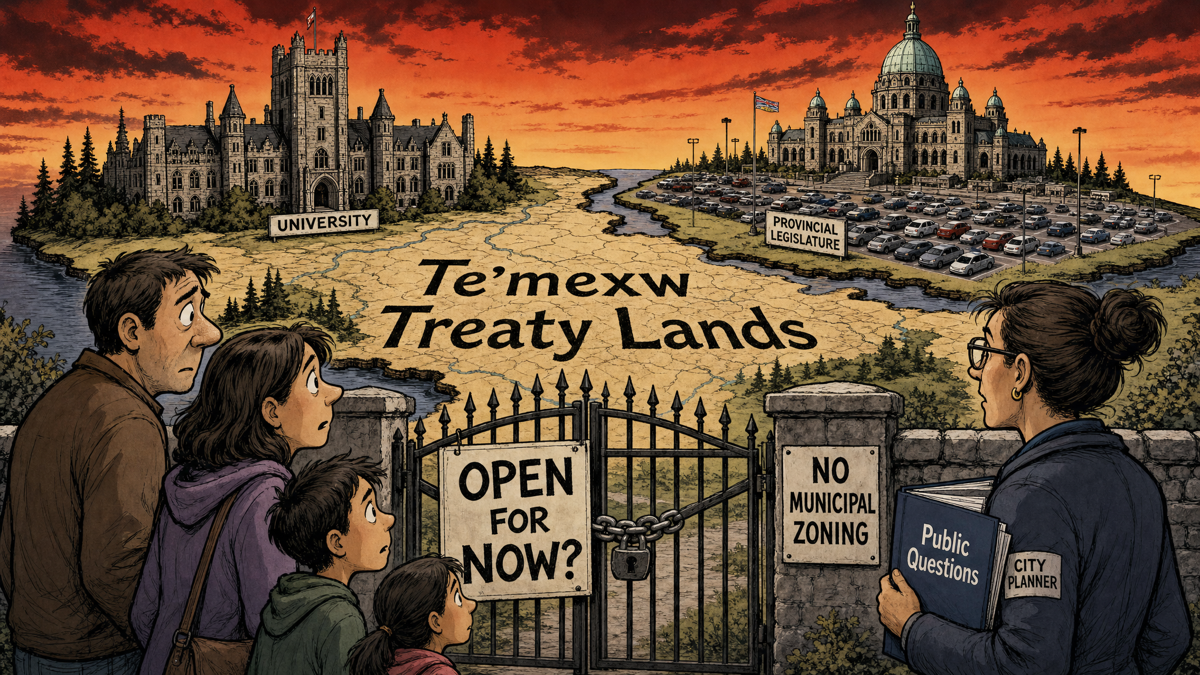
The Te’mexw treaty file has moved from a quiet technical process into a very public accountability test. CHEK News reports that the treaty package involves about 30 Crown-land parcels proposed for transfer to five Vancouver Island First Nations, including Hatley Castle and Royal Roads University lands, a parking lot beside the B.C. legislature, a downtown Victoria waterfront parking lot near Bastion Square, Discovery Island Marine Provincial Park and Sooke Mountain Provincial Park. CHEK also reports that no private land is involved.
That last point matters. This is not a claim that homeowners are being dispossessed. It is a claim that the public deserves straight answers when public assets, park lands and civic planning authority are being rearranged through modern treaties that will carry constitutional force.
The province’s own engagement page says the Te’mexw Treaty Association, Canada and British Columbia have been negotiating since 1995. It says five separate treaties are being negotiated for Malahat, Beecher Bay/SC’IȺNEW̱, Songhees, Snaw-naw-as/Nanoose and T’Sou-ke, and that the process is in Stage 5 of the B.C. treaty process. The same page says treaty members, B.C. and Canada still must approve the treaties before they take effect.
Those approvals should not be treated as a rubber stamp. The province states plainly that treaty lands will not be subject to local government zoning, and that each Treaty Nation will manage, zone and develop its treaty lands. That is a major governance change for parcels sitting inside or beside dense urban communities, public landmarks and existing park systems.
Public access is the other hard question. The province says public access and recreational opportunities will continue for Discovery Island Marine Provincial Park and Sooke Mountain Provincial Park, and that conservation values will be maintained. CHEK, however, reports that government consultation material warned some lands that have been available for public use could later have limited access or no public access once they become treaty lands.
Those two statements are exactly why the draft terms should be open to scrutiny. A promise of continued access is only as strong as the text behind it: who holds the obligation, how long it lasts, who enforces it, what exceptions exist, and what happens if future land-use plans change. The public should not have to infer the answer from summaries, interviews or poster boards.
Minister Spencer Chandra Herbert told CHEK the province is asking for public advice and wants to consider public thoughts. Good. Then the next step is obvious: release enough treaty text, parcel-specific access language and zoning consequences for citizens, local governments and affected institutions to test what is being approved. Reconciliation is too important to be handled with blind spots. Trust is built by showing the deal before asking the public to accept the consequences.