Tilbury’s Air-Quality Receipt: Show the Enforcement Ledger
The NDP approved Tilbury Phase 2 with jobs and conditions attached. New air-quality reporting makes the next test simple: show the monitoring, the thresholds and the consequences.
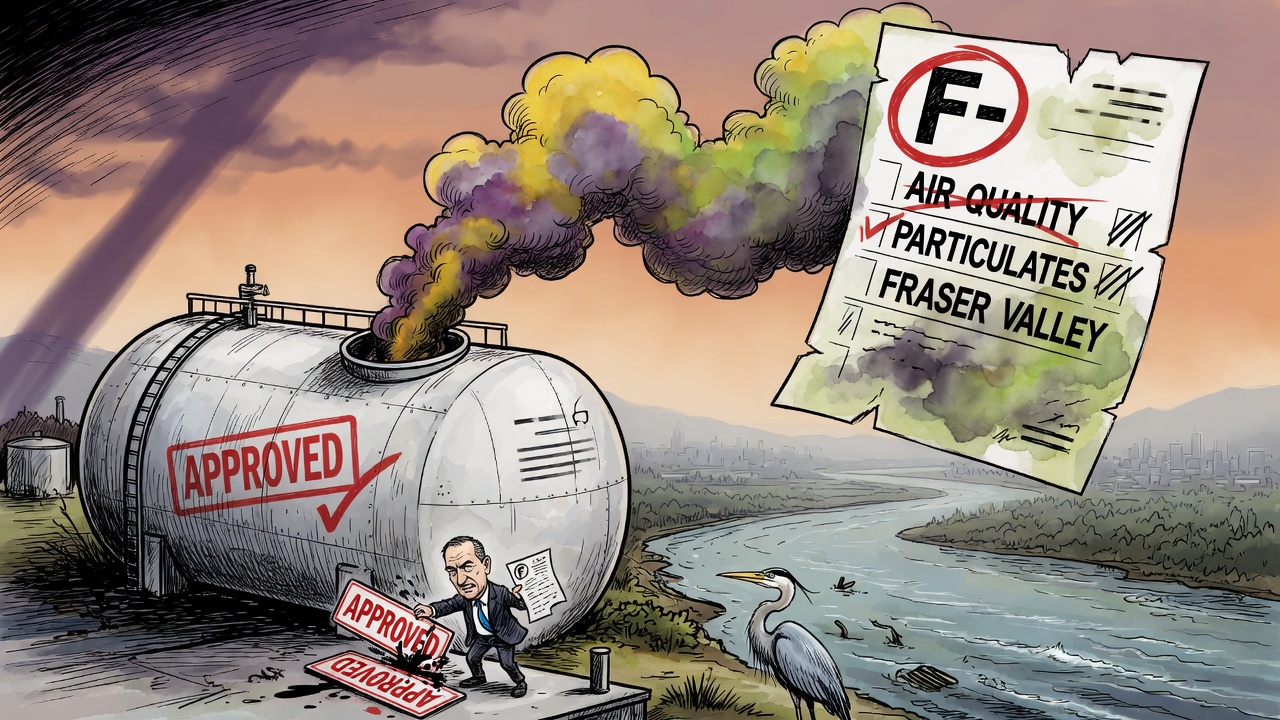
The Tilbury LNG decision has a new receipt. The Tyee reported October 9 that emissions from FortisBC’s recently approved Tilbury expansion are projected to exceed Canadian ambient air-quality standards for nitrogen dioxide, including sharply higher hourly levels during commissioning and equipment malfunctions.
That matters because the NDP government did not merely inherit this file. On September 21, B.C. issued an environmental assessment certificate for Tilbury Phase 2 on Tilbury Island in Delta. Environment and Parks Minister Tamara Davidson and Energy and Climate Solutions Minister Adrian Dix made the decision after reviewing the Environmental Assessment Office report, recommendations, First Nations consultation, technical advice and public input.
The government’s own release says the certificate contains 18 legally binding conditions, including air-quality controls and monitoring, greenhouse-gas reduction measures, health and emergency planning, public information and community feedback mechanisms, and ongoing monitoring of impacts to First Nations. It also sold the upside: FortisBC estimated up to 6,200 full-time-equivalent person-years of construction employment, about 100 permanent operating jobs, and as much as $1.7 billion in provincial GDP during construction.
Fine. If ministers want credit for jobs, GDP and “clean energy” branding, they also own the enforcement ledger. The Tyee reported company data projecting nitrogen dioxide levels during commissioning and malfunction scenarios at three to 16 times above Canada’s maximum hourly guidelines in parts of Richmond, Delta and Vancouver. It also reported projected slight exceedances of annual nitrogen dioxide standards during ongoing operations, extending across schools, homes and child-care centres in southern Richmond.
Those are serious words, so the public response should be serious, specific and boringly transparent. Which pollutants trigger which public alerts? Which monitoring stations will be used? How often will readings be posted? What happens if a condition is missed? Who has authority to pause activity, require mitigation, or penalize non-compliance? And will nearby residents see the same data regulators see?
The province says compliance and enforcement officers will monitor the project through construction and operation. That promise should become a public dashboard, not a footnote in a certificate. If mitigation is the reason ministers concluded significant adverse effects can be avoided, British Columbians deserve to see whether mitigation is working in real time.
The NDP cannot campaign as the party of competent climate management while treating air-quality accountability as a technical appendix. Tilbury may still proceed through remaining authorizations and investment decisions. But after this reporting, the political question is already here: did Eby’s cabinet approve a project with a real enforcement plan, or just another jobs headline with the hard numbers buried after the vote?
Sources and records
- The Tyee: A Delta LNG Project Is Expected to Push Emissions Past Standards
- BC Gov: Environmental assessment certificate issued for Tilbury Phase 2 LNG expansion
- BC Gov: Tilbury Phase 2 a major economic, clean-energy opportunity for B.C.
- Environmental Assessment Office: Tilbury Phase 2 LNG expansion project record