Eby Called Spring a Success. CityNews’ Scorecard Says Otherwise.
The premier’s end-of-session victory lap runs straight into the ledger British Columbians actually lived through: deficit pressure, DRIPA chaos, health-care strain and delayed projects.
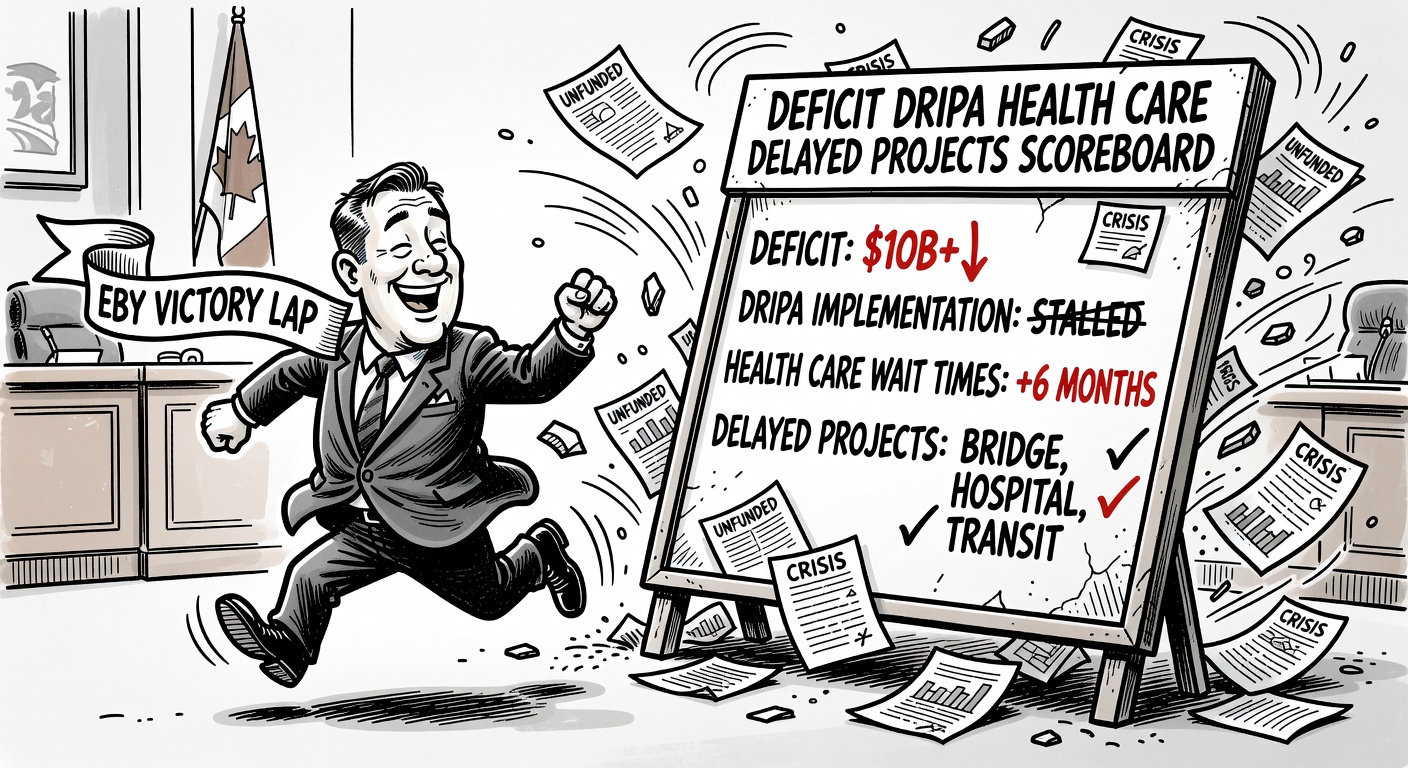
iVoteNDP editorial cartoon, May 30, 2026.
A government that has to declare its own session a triumph may be trying to outrun the scoreboard.
Premier David Eby’s government closed the spring legislative session with a polished release about “securing B.C.’s future.” The province pointed to more than $88 billion in proposed major projects nearing final investment decisions, 5,000 trades-training seats, lower rents, hydro-bill relief, U.S. health-care professionals hired and hundreds of thousands of people connected to primary care.
That is the victory-lap version. The public ledger looks very different.
CityNews reported Friday that MLAs left for summer break after a session in which the BC NDP was struggling in the polls and facing pressure on health care, the deficit and the economy. Its story cited Budget 2026’s three-year fiscal plan, including a deficit projected above $13 billion this year, public-sector reductions and longer timelines for capital projects.
That is not a footnote. It is the central contradiction of the Eby government: big promises, bigger bills and a shrinking margin for excuses. Budget 2026’s own release says deficits are projected to fall from $13.3 billion in 2026-27 to $11.4 billion in 2028-29. Even if everything goes according to plan, British Columbians are still staring at years of massive red ink.
Then came DRIPA. CityNews quoted University of the Fraser Valley political scientist Hamish Telford saying it did not look like much worked for the New Democrats during the session. He pointed to the budget, Indigenous-policy controversies and court cases that threw government a curveball. His assessment was blunt: Eby struggled with his own DRIPA law and could not get changes past his own caucus.
That matters because this was supposed to be the NDP’s competence argument. Instead, voters watched the premier sell certainty, confront legal uncertainty, propose a fix, retreat from it and then ask the public to trust him anyway. On the same file, the government is now talking about hidden court-case lists and urgent repair work. That is not stable leadership. It is damage control.
Health care did not rescue the session either. CityNews noted Telford gave B.C. some credit for recruiting American doctors and nurses, but said progress was not fast enough to give everyone a family doctor or keep every emergency room open. The government can count matches and hiring announcements. Patients count closed ERs, waiting rooms and the doctor they still do not have.
Infrastructure rounded out the scorecard. CityNews pointed to delayed and over-budget projects such as the Broadway Subway, while Telford raised the unresolved frustration around Massey Tunnel and North Shore bridge bottlenecks.
So yes, the NDP can issue a spring-session press release. But a press release is not a record. The record is debt, delay, DRIPA confusion and a health system still asking British Columbians to be patient. Eby says the session delivered results. The scoreboard says the government is still losing ground.