A Fully Costed $12B Deficit Is Still a $12B Deficit
David Eby’s campaign costing does not make the fiscal hole disappear. It asks voters to accept a smaller hole later, paid for with tax hikes and growth assumptions.
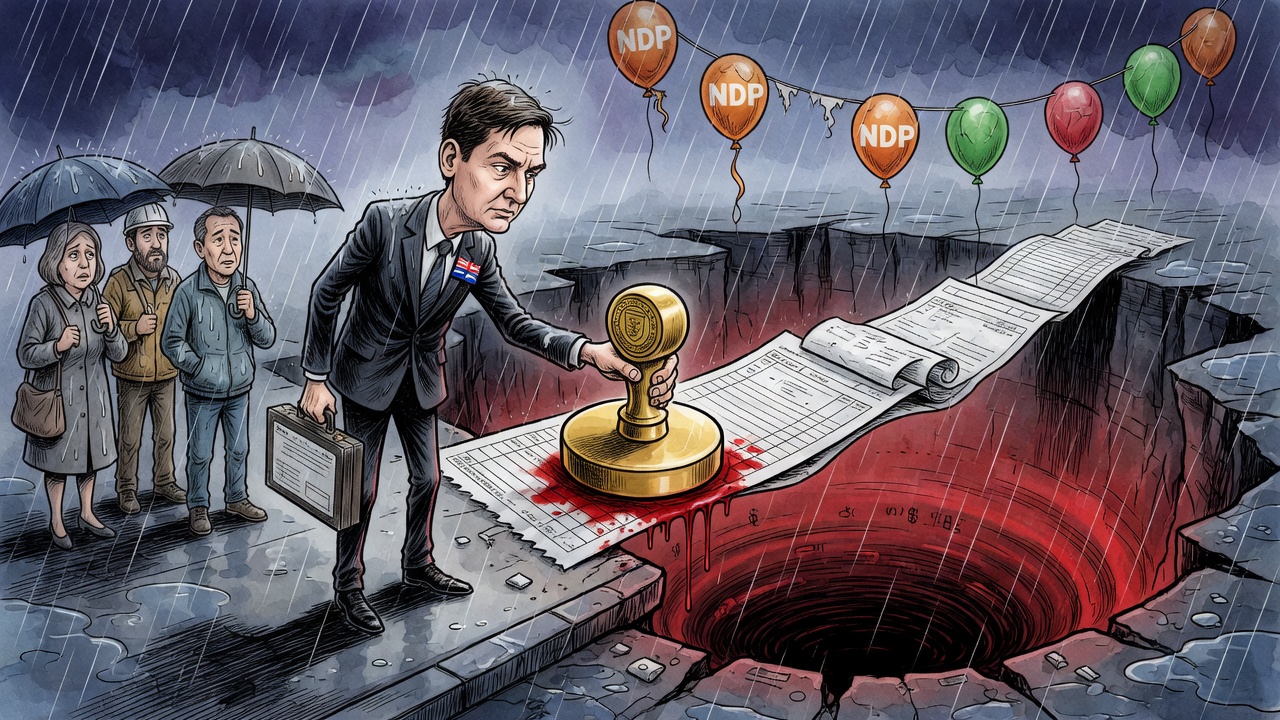
The BC NDP released the costing for David Eby’s campaign plan on Wednesday, saying new commitments would be paid for by asking the top 3.88 per cent of income earners to contribute more and by growing B.C.’s economy. That is the party’s frame: the plan is paid for, responsible, and aimed at services.
But the outside arithmetic reported the same day is harder to dress up. CityNews, citing the NDP platform costing during the leaders’ debate window, reported that the plan still shows a deficit of about $12 billion by 2028-29. That is lower than the Province’s current $13.8-billion deficit forecast for 2026-27, but it is not a balanced plan. It is a promise to remain deep in red ink.
The same report said the costing relies largely on $1 billion in new revenue from income-tax increases on the top 3.88 per cent and $730 million from “targeted economic growth.” Voters should read those two lines carefully. One is a tax increase. The other is a forecast. Neither cancels the duty to show how debt, interest and operating spending will be brought under control.
The government’s own First Quarterly Report already set the baseline. The Province forecast revenue of $86.3 billion, real GDP growth of 0.9 per cent for 2026, and a $13.8-billion deficit for 2026-27, $450 million worse than Budget 2026. It also warned that tariffs and global uncertainty would add pressure to sectors including forestry, aluminum and manufacturing.
Global News reported earlier this week that the proposed tax changes were projected by the party to raise $225 million in 2026-27, $925 million the next year, and $1 billion the year after. That gives voters the scale of the tax lever. It does not prove the wider fiscal plan is durable.
The Business Council of British Columbia has been blunt about the risk, arguing after the quarterly update that B.C.’s finances remain on an “unsustainable trajectory.” It pointed to total provincial debt doubling from $90 billion in 2021-22 to $180 billion in 2026-27, and debt-servicing costs tripling from $2.7 billion to $6.3 billion over the same period.
That is the public-interest test. A costed platform can still be a deficit platform. Eby is asking British Columbians to applaud a future $12-billion deficit because it is smaller than today’s $13.8-billion deficit. Voters deserve more than a slogan and a tax bracket. They deserve a line-by-line debt-service ledger, the spending-control plan, the contingency if growth misses target, and the date B.C. stops treating massive deficits as normal government.